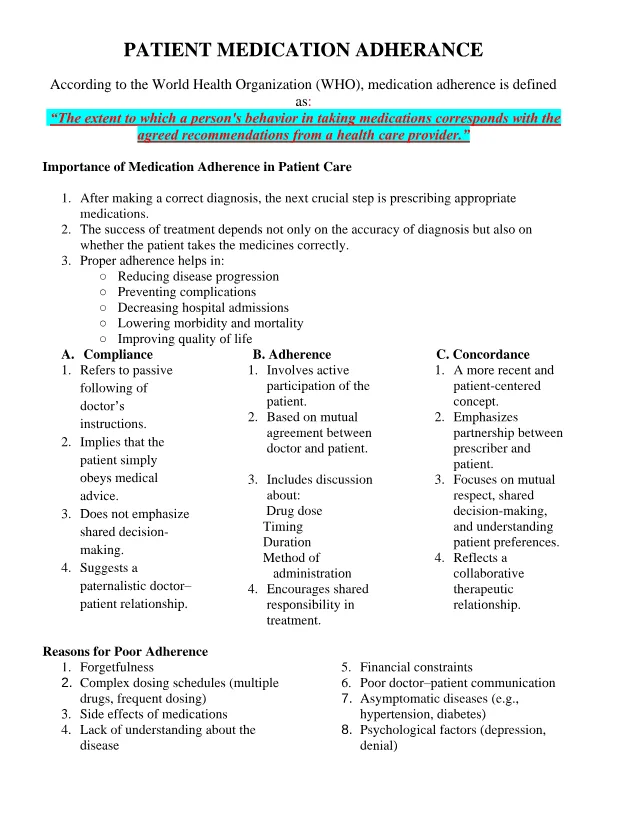
Comprehensive Geriatric Assessment (CGA): Optimizing Medication Use in Older Adults for Improved Health Outcomes
Presentation10 slidesB.Pharm, Pharm.D
Loading…
About this presentation
Systematic approach to identify, prevent, and manage drug-related problems in older adults, including medication history, assessment tools, prescribing guidelines, adherence strategies, and monitoring high-risk patients.
- geriatric assessment
- medication review
- drug-related problems
- medication adherence
- patient safety
Text of these slides
- Slide 1. preencoded.png Comprehensive Geriatric Assessment (CGA) A systematic approach to identify, prevent, and manage drug-related problems in older adults — optimising medication use for better health outcomes.
- Slide 2. preencoded.png History Taking in Older Adults Many older adults use a combination of prescription medications, OTC medications, and dietary supplements including herbal products, vitamins, and minerals. Obtaining a complete medication history is essential to safe care. Communication Problems Hearing impairment, vision impairment Underreporting Health beliefs, cognitive impairment Altered Disease Presentation Vague or nonspecific symptoms Polypharmacy Multiple illnesses and comorbidities Reliance on Caregivers Patient unable to provide history independently Limited Medical Records Incomplete documentation
- Slide 3. preencoded.png Information to Collect & the TIMER Tool What to Collect • Prescription medications • OTC drugs • Herbal products • Vitamins and supplements • Allergies and previous ADRs • Current medication concerns • Geriatric syndromes: falls, confusion, incontinence The TIMER Tool (Tool to Improve Medications in the Elderly via Review) helps pharmacists collect medication-related information systematically. Medication Organisation Strategies 01 Using a Pill Box 02 Laying Out Medications for the Whole Day 03 Keeping Medications in a Visible Place 04 Using a Checklist or Calendar
- Slide 4. preencoded.png Assessing & Monitoring Drug Therapy Comparing the medical problem list with the drug list This is a simple approach that identifies approximately two-thirds of prescribing problems . Overuse Medication is unnecessary because: • No indication exists • Drug is ineffective • Risks outweigh benefits • Therapeutic duplication exists Underuse Patient has a condition but is not receiving beneficial evidence- based therapy. Identifying omissions is equally critical to safe prescribing. Tools for Identifying Potentially Inappropriate Medications (PIMs) Tool Purpose Beers Criteria Identify potentially inappropriate medications STOPP Criteria Detect inappropriate prescribing EU-PIM List Identify harmful drugs in older adults
- Slide 5. preencoded.png Steps 2 & 3: Identifying Prescribing Omissions & Assess Remaining Medications Step 2: Identify Prescribing Omissions Determine whether evidence-based medications are missing from the patient's regimen. Tool Purpose START Criteria Identifies omitted beneficial medications AOU Criteria Assessment of Underuse Step 3: Assess Remaining Medications : Evaluate Dose Appropriateness Drug-Drug Interactions Drug-Disease Interactions Therapy Duration Cost Directions for Use
- Slide 6. preencoded.png Medication Appropriateness Index (MAI) Developed by Hanlon JT and Schmader KE (1992) to evaluate medication appropriateness in elderly patients. The evaluator assesses 10 criteria across three weighted categories. MAI Weighting System Criterion Weight Indication, Effectiveness 3 Dosage, Directions, Drug-Drug Interaction, Drug-Disease Interaction 2 Practicality, Duplication, Duration, Cost 1 Score Interpretation Total Score Interpretation 0 Completely Appropriate 18 Maximally Inappropriate 10 MAI Assessment Criteria 01 Indication 02 Effectiveness 03 Dosage 04 Directions 05 Practicality 06 Drug-Drug Interactions 07 Drug-Disease Interactions 08 Duplication 09 Duration 10 Cost
- Slide 7. preencoded.png Beers Criteria The American Geriatrics Society (AGS) Beers Criteria is a list of medications that should generally be avoided or used cautiously in older adults because the risks outweigh the benefits. History & Purpose • Developed by Mark Beers in 1991 • Updated every 3 years by the AGS • Latest major revision: 2019 Goals • Improve prescribing quality • Reduce inappropriate medication use • Prevent ADRs • Educate healthcare professionals What It Includes Category Number Drugs/classes generally to avoid ~30 Drugs/classes to use cautiously or avoid in specific diseases ~40 Beers Criteria should be used as a guide, not an absolute rule . Clinical judgement and patient-specific factors must always be considered.
- Slide 8. preencoded.png Documenting Problems, developing therapeutic plan & Consulting the Prescriber Developing a Therapeutic Plan After medication review, the clinician should: • Document all drug-related problems • Develop targeted interventions • Establish age-appropriate therapeutic goals Treatment goals for an 80-year-old patient may differ significantly from those for a 40-year-old patient. Consulting the Prescriber Prescriber consultation serves to: • Promote continuity of care • Facilitate team-based management Optimise prescribing before implementing adherence interventions. Improving adherence to an inappropriate regimen may increase patient harm.
- Slide 9. preencoded.png Counselling & Adherence The WHO Five Dimensions affecting adherence must be addressed holistically to support older adults in managing their medications effectively. Social/Economic Cultural beliefs, finances Healthcare System Provider-patient relationship Condition-Related Chronic diseases Therapy-Related Complex regimens Patient-Related Vision/hearing impairment General Strategies • Simplify medication schedules • Match regimens to patient lifestyle • Use generic medications • Reduce copayments • Use formulary-preferred drugs Adherence Aids • Pill organisers and medication calendars • Medication records and special packaging • Dose-measuring devices • Magnification devices for insulin syringes • Spacers for inhalers
- Slide 10. preencoded.png Documenting Interventions, monitoring Progress & Targeting High-Risk Patients Documentation Should Include • Drug-related problems identified • Recommendations provided • Interventions implemented • Patient response • Follow-up plans Good documentation improves continuity of care, tracks outcomes, and facilitates communication among healthcare providers. High-Risk Patients: Prioritise When Resources Are Limited Polypharmacy risk: ≥7 medications OR 3 cardiac medications High-Risk Medication Classes Anticoagulants Antidepressants Anti-infectives Antipsychotics Anticonvulsants Opioid Analgesics Sedative-Hypnotics Skeletal Muscle Relaxants